


The Toyota Way: How Companies That Copy Toyota Fail
Jeffrey Liker spent 20 years studying Toyota’s factories to distill 14 principles. The most surprising part: 13 of them have nothing to do with production. By Mounir Telkass, founder of MT-Transition.
☎ Call: +33 6 59 15 73 54 Request a call back within 2 business hoursCallback within 2 business hours · 3 targeted profiles within 72h · 100% industrial
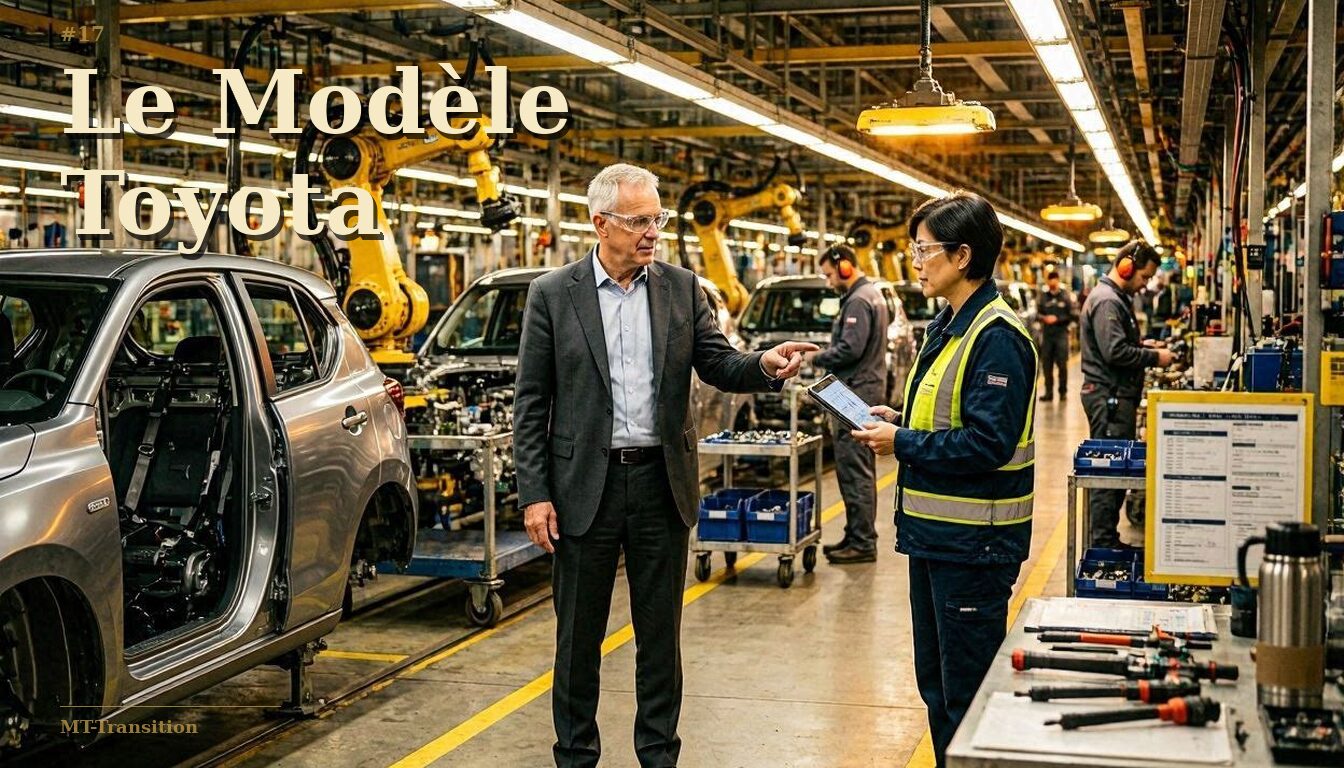
Jeffrey Liker is a professor of industrial engineering at the University of Michigan. He began studying Toyota in the 1980s, at a time when American manufacturers viewed Japanese industry with a mix of contempt and incomprehension. He spent two decades interviewing engineers, managers, and operators on both sides of the Pacific. The Toyota Way, published in 2004, is the result of that immersion.
The book lays out 14 principles that structure the Toyota system. It took 14 because Liker quickly understood something essential: what Western companies had copied from Toyota was not the Toyota Way. It was the visible surface: the tools. And copying the tools without understanding the principles is the surest way to fail expensively and durably.
The Toyota paradox has been known to manufacturers for 30 years. Delegations from around the world visit the factories. They leave with notebooks full of kanban, 5S, andon. They roll it all out. And three years later, nothing has fundamentally changed.
1. The 4 Categories: The Toyota Way Is Not a Toolkit, It’s a System of Thought
This first principle is not a tool. It is a reading grid: the grid that makes the other 13 understandable.
« The 4P model: Philosophy, Process, People & Partners, Problem Solving. Long-term thinking is the foundation. Without it, everything else is just a set of techniques. »
Long-term philosophy: long-term decisions take priority over short-term gains, even at the cost of immediate financial losses. Process: eliminating waste is not optional. People and partners: developing individuals and teams, respecting suppliers as extensions of the organization. Problem solving: go and see, understand deeply, learn continuously.
For an industrial director arriving on assignment, this grid is the first audit filter. The question is not « do they have kanban boards? » but « do they decide for the long term or the short term? », « do they trust their operators to stop the line? »
2. Genchi Genbutsu: Decisions Are Made Where the Work Happens
« Genchi Genbutsu » is one of the least copyable principles of the Toyota Way, because it directly challenges how leaders believe they are supposed to lead.
« Go and see for yourself to thoroughly understand the situation. Apply genchi genbutsu to your work. Think and speak based on personally verified data. »
The literal translation is « go to the real place, see the real thing. » In a Toyota organization, no production decision is made from a meeting room with slides.
For a production director arriving on assignment, Genchi Genbutsu has a concrete, practical translation: the first 48 hours of a mission are spent on the shop floor, not in a meeting room. Follow a part from raw material intake to customer delivery. Talk to line operators. See where things stall, where they pile up.
3. The 5 Whys: Root Cause, Not Apparent Cause
The 5 Whys method was invented by Taiichi Ohno, the father of the Toyota Production System.
« By repeating why five times, the nature of the problem as well as its solution becomes clear. »
The principle is simple. When a problem arises, ask « why? » five times. Almost always, the root cause sits 4 or 5 levels deeper than the apparent cause. In most mid-sized industrial companies, the dominant culture is to fix apparent causes. The result: the same problems keep coming back, regularly, in slightly different forms.
An industrial director arriving on assignment should, within the first 30 days, map the site’s 5 most recurring problems and apply the 5 Whys with the relevant team.
A System, Not a Set of Tools
A 320-person mid-sized manufacturer of industrial equipment, B2B market, 60% export. Ten years of history with quality and continuous-improvement initiatives. On paper: an advanced organization. In reality: lead times drifting for three years, customer complaints rising. The group brings in an industrial director for transition management for a 10-month assignment.
4P diagnosis: weeks 1 to 3. Long-term philosophy? Senior management switches suppliers with every tender. People? Operators are not allowed to stop the line. Diagnosis: an organization that had rolled out the forms of the Toyota Way without any of its principles.
Genchi Genbutsu: days 1 to 5. The director spends the first two days physically following the flow of a single component. Four invisible flow breaks surface: none of them visible on the dashboards.
5 Whys: month 2. The director picks the most recurring problem: rework after final inspection, stable at 12% for three years. Root cause identified: a fitting tolerance transferred without verification four years earlier. The rework rate drops from 12% to 4% in two months.
Ten months later: cost of non-quality reduced from 4% to 1.8% of revenue. On-time delivery up to 91%, from 73% at the start of the assignment.
Key Takeaways
The Toyota Way is not a catalog of tools. It is a four-layer system of thought. Companies that copy the tools without the long-term philosophy consistently get poor results.
Genchi Genbutsu: the first 48 hours of an assignment happen on the shop floor, not in the boardroom. What operators know about a site’s real problems is systematically more accurate than what the dashboards measure.
The 5 Whys reveal that most recurring problems have never been properly framed. The root cause almost always sits 4 or 5 levels deeper than the apparent cause.
A managerial transformation to lead at your site?
MT-Transition places industrial transition managers trained in these methods, ready to step in within a few weeks.
☎ Call: +33 6 59 15 73 54 Request a call back within 2 business hoursRelated pages
- Industrial Director for Transition Management
- Production Director for Transition Management
- Automotive Transition Management
- Quality & HSE Director for Transition Management
- What Is a Transition Manager?
- Extreme Ownership (Willink & Babin)
The Toyota Way is often presented as the reference book on Lean. That is not quite right. It is, rather, the book that explains why the Lean that spread outside Toyota was never really Lean, and what should be done instead.
Let’s talk about your situation
A first phone call, no commitment, to scope your need.
☎ Call: +33 6 59 15 73 54 Request a call back within 2 business hours