


Extreme Ownership (Jocko Willink & Leif Babin): Total Leader Accountability Applied to Industry
What two Navy SEALs understood about leader accountability in Extreme Ownership, and how it changes everything about taking on a mission inside a struggling organization. By Mounir Telkass, founder of MT-Transition.
☎ Call: +33 6 59 15 73 54 Request a call back within 2 business hoursCallback within 2 business hours · 3 targeted profiles within 72h · 100% industrial
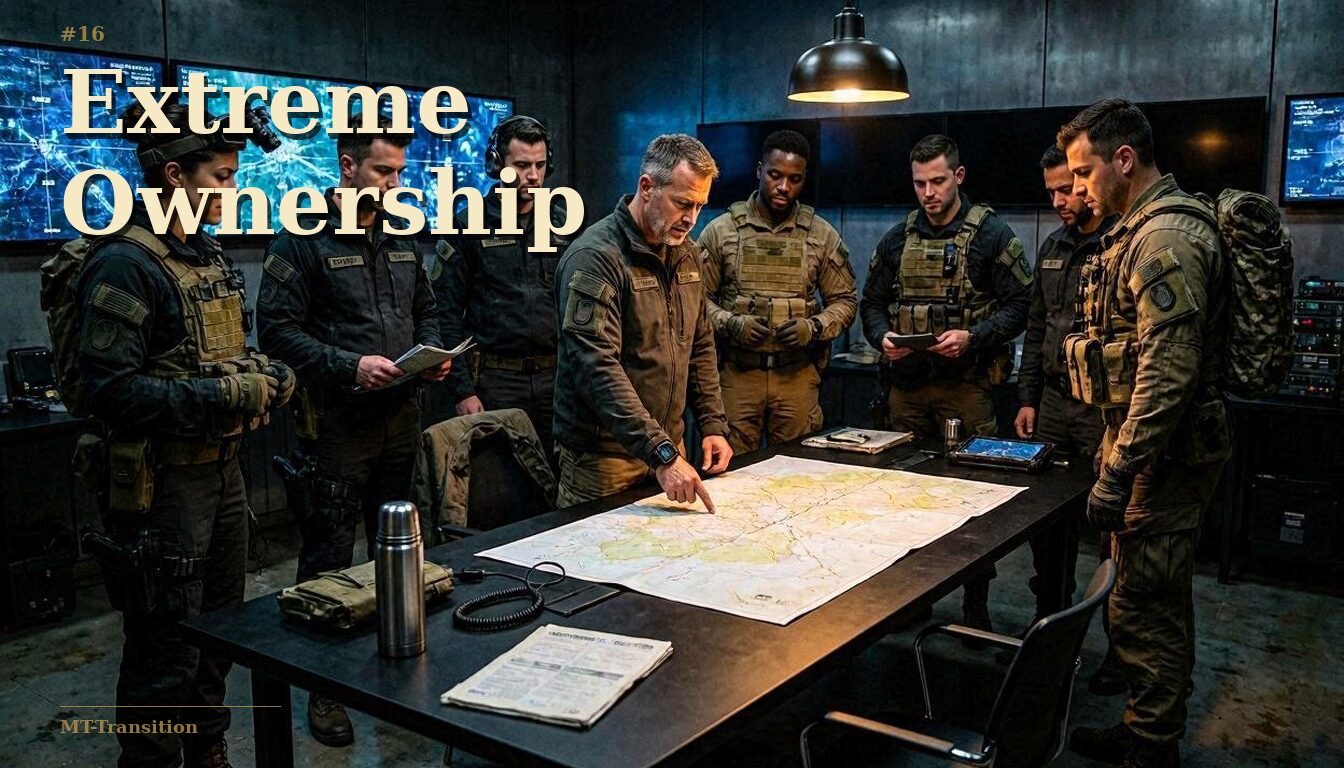
Jocko Willink is a former SEAL commander of Task Unit Bruiser, one of the most decorated combat units of the Iraq War. Leif Babin was his second-in-command. Together, they led operations in Ramadi in 2006: one of the most violent periods of that conflict. Extreme Ownership was born from a simple question: why do some units succeed in their missions amid chaos, while others fail?
The answer they give is uncomfortable, because it is simple and unequivocal. No complex strategy, no sophisticated process. A single variable: the quality of leadership of the person in command. And a single rule that structures everything else.
This book is not a military manual. It has been read by hundreds of thousands of business leaders worldwide, precisely because its principles apply word for word to the situation transition managers face: arriving in an organization they don’t know, with a team they didn’t choose, in a context that is often degraded, and a mission to succeed within a few months.
1. Extreme Ownership: The Leader Is Always Responsible, No Exceptions
This is the book’s central principle, and the most uncomfortable one for leaders accustomed to sharing responsibility with their environment.
« The leader is truly and ultimately responsible for everything. There are no bad teams, only bad leaders. »
They illustrate it with a brutal episode. During a training exercise, Willink oversees two competing SEAL teams. The first is made up of elite soldiers: it wins systematically. The second, less well trained, fails regularly. A superior makes a decision: swap the leaders. The result? The second team starts winning. The first starts losing. The soldiers hadn’t changed. The leader had.
For a transition manager, this rule has immediate practical consequences. The temptation, on arriving in a struggling organization, is to build a narrative about the team you inherit. Those observations may well be true. They don’t exempt you from the result.
Extreme Ownership means an industrial director who isn’t getting the expected results can look for the cause in only one place: their own way of leading, communicating, prioritizing. An industrial director starting a mission should set a simple rule for the first 30 days: never frame a problem by starting with “the team…”
2. Cover and Move: Teams Support Each Other or They All Lose
The second principle comes from military operational vocabulary. “Cover and Move” describes the tactic where one unit advances while another provides it cover, then the roles reverse. It’s the principle of interdependence in action: no unit can accomplish its mission alone.
« Cover and Move means teamwork. All elements within the greater team must work together to accomplish the mission, mutually supporting one another for that singular purpose. »
This is the exact diagnosis found in almost every struggling mid-sized industrial company: the teams that lose are the ones optimizing for themselves at the expense of the overall mission. A sales department signing orders that are impossible to deliver without talking to production. An operations department refusing to take on off-schedule emergencies. A quality department blocking shipments without giving a clear resolution timeline.
For a transition manager arriving in this context, the first mission is not to “fix” team behaviors. It’s to identify who covers what, and who refuses to. Cover and Move, in a site turnaround mission, translates into a concrete action: explicitly define the interfaces between functions that must collaborate, with shared indicators.
3. Prioritize and Execute: In a Crisis, One Problem at a Time
The third principle is counterintuitive for any leader trained to “manage several fronts simultaneously.” Willink and Babin argue the opposite:
« When multiple problems occur simultaneously, a leader must be able to determine which problem is most critical. When overwhelmed by the complexity of a situation, step back, breathe, and determine the highest priority task. »
They call this saturation the “Spaghetti Bowl”: the situation where problems intertwine to the point the leader no longer knows where to start. The rule they set is simple: prioritize, then execute one after another, not simultaneously. Identify the problem most critical to the mission, concentrate all available resources on it, then move to the next.
For a general manager starting a mission, this is the hardest decision of the first few weeks. Willink and Babin argue that the leading cause of leader failure in a crisis situation is not the difficulty of the problems, but dispersion.
Three Principles in Action
French subsidiary of an international industrial group, 180 employees, precision mechanical components manufacturing. Three years of underperformance: costs off-plan, high turnover in production, tense relations between sales and operations. The group appoints a transition director for 9 months with a mandate to stabilize.
Extreme Ownership: weeks 1 to 4. The industrial director gives up trying to hold a “neutral” diagnosis of the inherited teams. He presents the results of the last 3 years as his own record from day one. Transparency rises because the leader has absorbed the responsibility.
Cover and Move: months 2 to 3. Flow analysis reveals the main bottleneck: sales signs deadlines without consulting planning. The industrial director creates a weekly 45-minute ritual (sales, planning, supply chain) with a single shared indicator: the customer commitment fulfillment rate.
Prioritize and Execute: months 2 to 9. Faced with a list of 14 workstreams identified in the initial diagnosis, the industrial director announces 2 to the shareholder board. 9 months later: planning fulfillment rate up from 61% to 87%, production resignations cut by 3.
Key Takeaways
Extreme Ownership is not a moral posture. It is an operational lever. A leader who accepts total responsibility changes the organization’s culture within the first few weeks, because it removes the individual self-protection logic that prevents real information from surfacing.
No team can optimize itself alone without undermining the organization. Cover and Move means structuring interfaces, creating shared indicators, and making interdependence visible.
Dispersion kills more missions than difficulty does. In a crisis, a leader’s value is measured by their ability to say “not now” to 12 problems in order to solve 2.
A managerial transformation to lead at your site?
MT-Transition places industrial transition managers trained in these methods, ready to step in within a few weeks.
☎ Call: +33 6 59 15 73 54 Request a call back within 2 business hoursRelated pages
- General Manager for Transition Management
- Industrial Director for Transition Management
- Industrial Site Turnaround Mission
- Supply Chain Director for Transition Management
- What Is a Transition Manager?
- Turn the Ship Around (David Marquet)
Extreme Ownership is probably the most widely read leadership book among military programs turned civilian. What makes it useful for industrial leaders is not the military analogy, but the fact that its principles were forged in an environment where leadership mistakes cost lives. The standard is proportional.
Let’s talk about your situation
A first phone call, no commitment, to scope your need.
☎ Call: +33 6 59 15 73 54 Request a call back within 2 business hours