


80% of Lean Programs Deployed in French Mid-Sized Industrial Firms Are Not Lean
James Womack and Daniel Jones, MIT researchers, spent five years extracting the universal principles of the Toyota Production System. Thirty years after Lean Thinking, most Lean programs deployed in France are toolboxes that have lost the original doctrine. By Mounir Telkass, founder of MT-Transition.
☎ Call: +33 6 59 15 73 54Request a call back within 2 business hours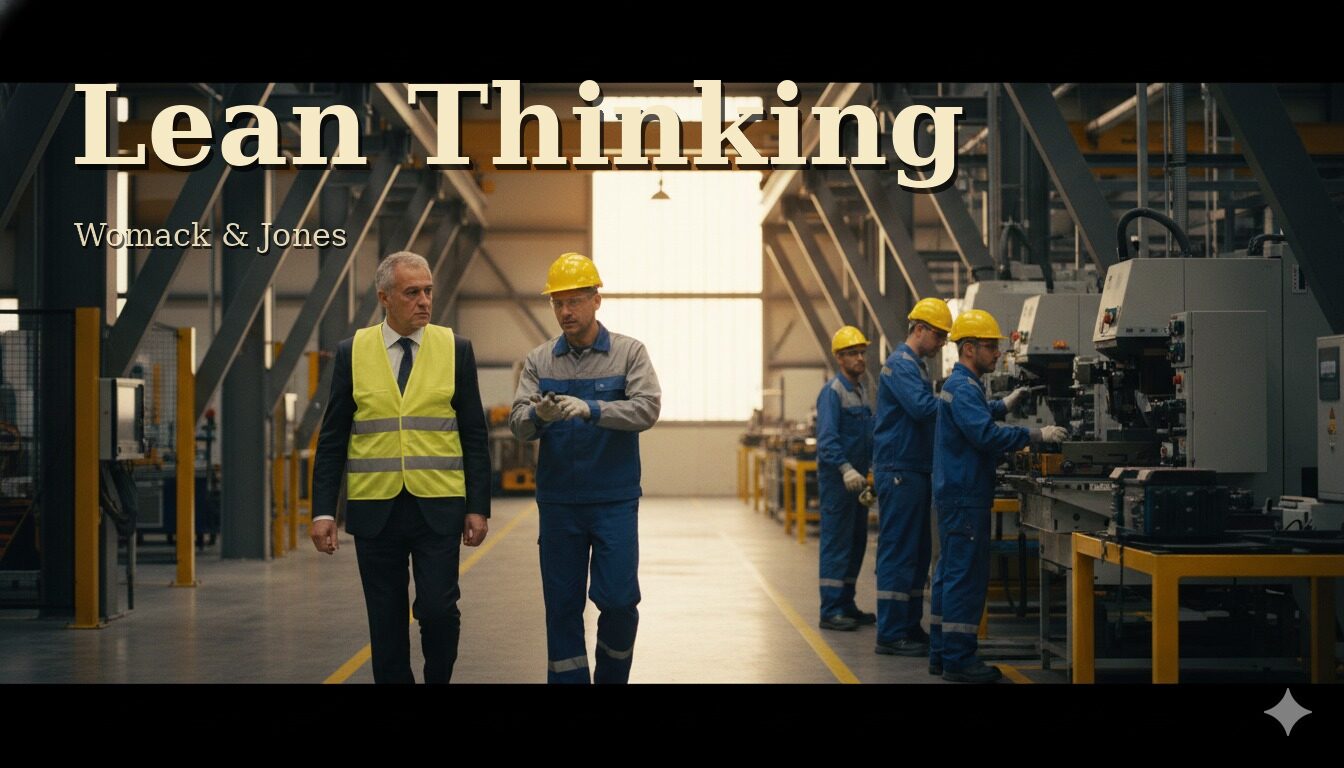
James Womack and Daniel Jones are two MIT researchers. For five years, they studied the Toyota Production System: not to describe it technically, that had already been done, but to extract from it the universal principles transferable to any industry. The result is Lean Thinking, published in 1996. The word “Lean” itself was coined by them.
What has happened to Lean over the past thirty years is tragic. Instead of remaining what Womack and Jones had formulated (a structuring doctrine for industrial organization), it has become, in most French mid-sized firms, a toolbox: 5S, kanban, sticky notes on the walls, flash kaizen, A3 reports. Tools that, stripped of their original doctrine, lose most of their value.
01, Define Value From the Customer’s Point of View, Not the Internal One
The book’s founding principle, and the most systematically violated. Womack and Jones point out that value is almost never defined by producers, for a simple reason: a producer defines value based on what it knows how to make, its tools, its processes. The customer, on the other hand, defines it based on what they need. These two definitions almost always diverge.
Concretely, before any Lean project, there is one thing to do that most mid-sized firms skip: go and see the end customer and redefine with them what actually has value in the delivered product, not in the technical data sheet, in real-world use. The result almost always lands on the table: certain functions the plant invests heavily in have no perceived value for the end customer, while others considered secondary internally are critical to them.
This is the first step of any real industrial transformation project, before any mapping, before any optimization. An industrial director on a transition assignment should schedule three to five in-depth customer interviews within the first thirty days, even if this step was not requested.
02, Map the Value Stream to See What Doesn’t Add Value
Second principle, and the book’s most powerful tool: value stream mapping. For each product family, trace every step the raw material goes through from supplier to customer: not just the transformation steps, but also transport, waiting, inspections, rework, intermediate storage, movements, approvals, queues.
For each step, two questions: does it add value from the end customer’s point of view? Is it necessary as things currently stand? Womack and Jones report that, in the plants studied before the introduction of Lean, less than five percent of the time a part spends in the plant is value-added time. The rest can be eliminated or drastically reduced.
No serious Lean project is conceived without this mapping as a first step. And yet, in most French mid-sized firms that call themselves lean, no real mapping has ever been done: tools were deployed without knowing where the real waste actually is.
03, Make the Flow Flow, No Stock Between Steps
The third principle, and the most counter-intuitive for management trained in batch thinking. Once value is defined and the chain mapped, the point is to make the flow flow: organize the sequence of steps so that the part never stops. No intermediate stock, no work-in-progress waiting around.
This is the opposite of the optimized-batch production doctrine that dominated Western industry for seventy years. Work-in-progress ties up cash, lengthens lead times, hides quality defects and prevents any response to variability. Making the flow flow requires a radical reduction in changeover times, cellular layout, cross-training and scheduling calibrated to actual demand, not machine capacity. This is not a quick win. It is six to twelve months of work, but it is what durably transforms a site’s performance.
A Real Lean Transformation
French industrial mid-sized firm, two hundred eighty people, tier-two subcontractor in aerospace. “Lean” program deployed for four years: 5S everywhere, kanban in place, formalized kaizen approach. On paper, a model of good practice. In reality, delivery lead times stable for five years, margins eroding, social climate deteriorating. The group appoints an industrial director on a transition assignment for twelve months.
Redefining value: month one. Four field interviews with end users, not the buyer. Three costly specifications in the requirements document turn out to be administrative fossils. Two critical, non-contractual expectations make the difference in day-to-day assembly.
Value stream mapping: months two and three. Average lead time of thirty-two days, of which five hours is value-added. None of the four previous years of Lean had ever produced this diagnosis.
Flow redesign: months four to twelve. Cellular reorganization, cross-training, changeover time reduced from four hours to thirty-five minutes, scheduling calibrated to customer demand. Twelve months later, lead times down from thirty-two to nine days, work-in-progress cut by three, gross margin restored by four points.
Key Takeaways
Value is defined by the end customer, not by producers. Without direct interviews with the user, you optimize things that have no value.
Value stream mapping is the most useful diagnostic a site can run. Without it, Lean tools serve no purpose.
Making the flow flow is not an option within Lean, it is Lean. Small batches, cells, cross-training, demand-driven scheduling. It is demanding, it is long, it is the only transformation that holds up durably: including for a production director who inherits a site where Lean already exists on paper.
You can display kanban boards in a workshop and do no Lean at all. You can do Lean without displaying a single visible tool. What matters is the principles, not the tools.
Mounir Telkass: MT-Transition, a transition management firm for industry.
A Lean Program Running Out of Steam?
MT-Transition places industrial directors on transition assignments who restore Lean’s original doctrine, not just its tools.
☎ Call: +33 6 59 15 73 54Request a call back within 2 business hoursResponse within 24 business hours.