


The WHY as a Diagnostic Tool, Not a Statement of Intent
“Start With Why” is often reduced to a lesson on purpose. Simon Sinek actually describes a mechanism of mobilization: why some leaders trigger genuine engagement while others only get compliance. Applied to industry, the Golden Circle becomes an organizational diagnostic tool, not a communication exercise. By Mounir Telkass, founder of MT-Transition.
Call Mounir Telkass Discuss your needs Response within 24 business hours: no-commitment first call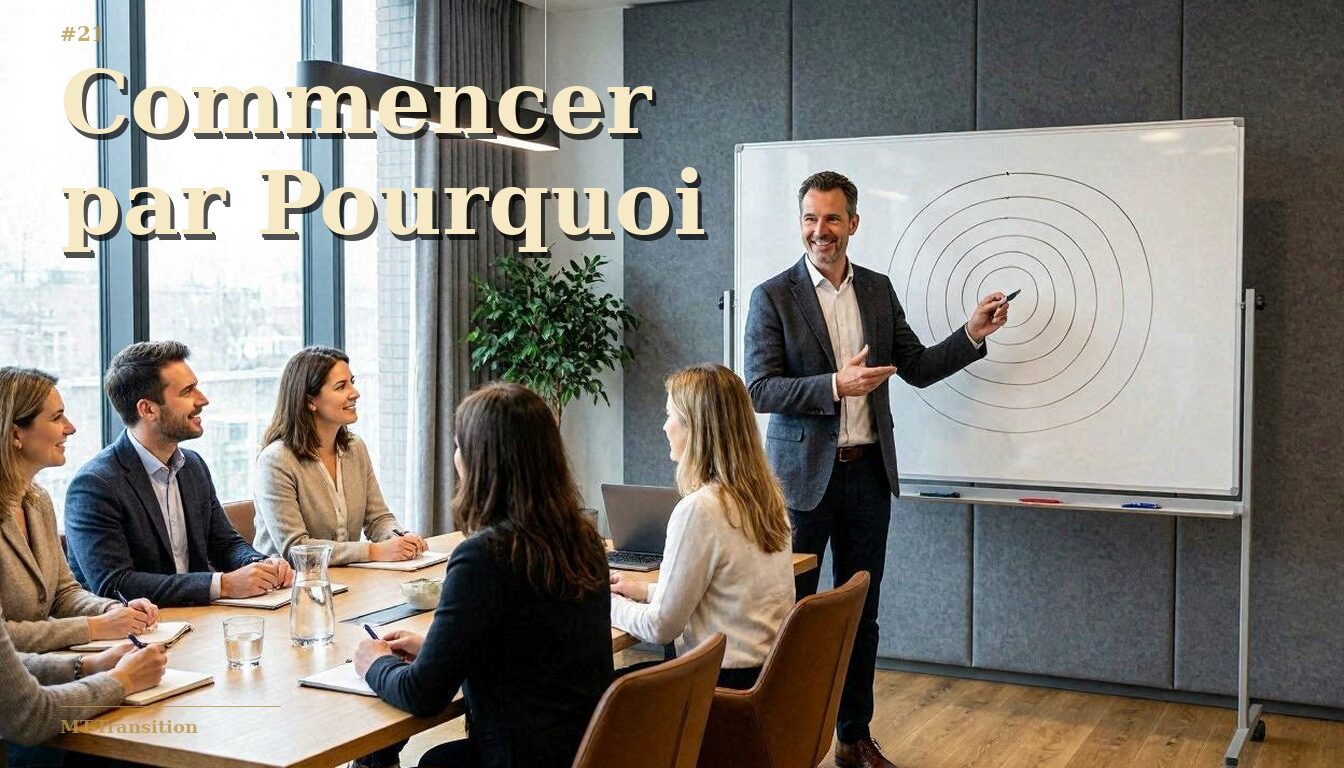
“Start With Why” is often summarized as a lesson on purpose. That reading is too comfortable. Sinek actually describes a mechanism of communication and mobilization: why some leaders trigger engagement where others only get compliance, why some companies survive crises while others disappear with the same level of resources.
Applied to industry, the angle is not inspirational. It is operational. A transition manager who joins a mid-sized company without understanding its WHY works on symptoms, not causes. He may produce short-term gains, and leave a weakened organization behind.
The book was published in 2009. It has aged unevenly. Some examples feel dated. But the analytical framework (the Golden Circle, the law of diffusion of innovation) remains one of the most precise tools for diagnosing why an organizational transformation succeeds or fails.
The Golden Circle, Diagnosing from the Center
“Every organization on the planet knows WHAT they do. Some know HOW. Very few know WHY.”
WHAT: the products, services, processes. HOW: the differentiating methods, skills, ways of working. WHY: the reason to exist beyond profit, what mobilizes teams and shapes decisions over time.
Most companies communicate from the outside in: WHAT, then HOW, then WHY, if the WHY is even articulated at all. Organizations that mobilize durably do the reverse.
Industrial application: for a transition manager, the Golden Circle is first a diagnostic tool. Which layer does the real problem sit in? A plant that is “losing competitiveness” (WHAT) often hides a HOW problem: obsolete processes, eroded skills. But an organization that no longer knows why it does what it does, its WHY erased by years of financial reporting, presents a different pathology, one that won’t respond to the same interventions.
Industrial equipment manufacturer, 300 employees, automotive subcontractor for 30 years. The teams know how to make parts. They no longer know for whom, or why it matters. When their main client announces a 35% drop in volumes, the internal reaction is resignation, not mobilization. The transition director spends the first three weeks reconstructing the WHY: which customers need this plant, for what, and with what consequences if it disappears. This reconstruction work precedes any action plan.
The Law of Diffusion of Innovation, Who to Convince First
“You have to find the people who believe what you believe.”
Sinek borrows Everett Rogers’s diffusion of innovation curve: innovators (2.5%), early adopters (13.5%), early majority (34%), late majority (34%), laggards (16%). The key lies in the 16% on the left side: the innovators and early adopters.
These individuals don’t get on board because it’s logical. They get on board because they believe in it. And they are the ones who convince the majority: not senior management, not the presentation slides.
Industrial application: in an industrial transformation, identifying the internal 16% who believe in the project is the most underestimated variable. They are not necessarily managers. They are often technicians, team leaders, salespeople who want it to work, and who carry informal influence with their peers. A transition manager who spends energy convincing skeptics wastes his time. One who identifies and equips the 16% generates a movement the skeptics later join.
Logistics site, 150 employees, flow redesign project as part of a digital transformation. The transition director informally maps the project’s “believers” in the first few weeks: 3 team leaders, 2 experienced forklift operators, 1 quality manager. He brings them into the working group: not for show, to decide. Six months later, they are the ones training new hires. The transformation wasn’t imposed, it was carried from within.
“People don’t buy what you do, they buy why you do it”
“The goal is not to do business with everybody who needs what you have. The goal is to do business with people who believe what you believe.”
Applied to internal organizations: teams don’t commit to an action plan. They commit to a cause, or to someone who embodies one. The difference between a manager who mobilizes and a manager who pressures is not a question of charisma. It is a question of consistency between what he says, what he does, and why.
A transformation plan spread across 47 slides explains the WHAT (the objectives) and the HOW (the initiatives). It leaves the WHY question wide open: why is this fight worth having? Teams don’t ask the question explicitly, but they answer it through their real level of engagement.
Industrial application: the transition manager who articulates his mission’s WHY (not as a slogan, but as an operational conviction) gets a different quality of engagement. “We are going to cut costs by 15%” produces compliance. “We are going to make this site competitive so the 280 people here still have a job in 3 years” produces something else entirely.
Foundry, 280 employees, threatened with closure by the parent company. The transition director does not present a “rescue plan.” He says what he believes: this site has the skills to make what no one else in Western Europe can still make, and the parent company knows it. The work of the next 12 months is to prove it with numbers. Result: absenteeism down 4 points in 3 months. No bonus, no profit-sharing scheme. Just a clear WHY.
The 3 Techniques in Action
Mid-sized industrial company, technical plastics sector, 190 employees. Acquired by a fund 18 months earlier. Middle management has lost the big picture: teams execute processes without understanding the direction.
Golden Circle diagnostic, week 1. The transition director doesn’t launch a financial audit. He spends two days in workshop with the production teams and inside sales staff. Central question: “What do our customers find nowhere else?” The answers surface a WHY no one had articulated since the acquisition: the ability to deliver short runs in 72 hours on complex technical materials, a real competitive advantage, never commercially leveraged.
Identifying the 16%, week 3. Informal mapping. Four people in the organization believe the company can grow rather than just endure. Two are methods technicians, one is a customer service manager, one is a junior sales rep. They are brought into the transformation steering committee.
Operational WHY, month 2. The transition director publicly articulates the mission: “Make this site the European reference for short-run technical plastics, and build the numbers that force the fund to recognize it.” Not a slogan. A direction. The 4 “believers” start carrying it forward. The response rate on internal surveys climbs from 31% to 68%.
End of assignment (10 months): revenue on short runs grows by 22%. The fund indefinitely postpones any thinking about a sale. The transition director’s mission is extended into an interim general management role while a permanent successor is sought.
Key Takeaways
The WHY is a diagnostic tool before it is a communication tool. If you don’t know why the company exists for its teams, you don’t know what you’re actually steering.
Invest in the 16% who already believe, not the skeptics. The majority follows the early adopters, not senior management’s slides.
The difference between engagement and compliance is built in the first few weeks. How you articulate your mission’s WHY determines the type of energy you get back.
A leader who has lost their organization’s collective WHY?
A transition manager can rebuild meaning before rebuilding results. No-commitment first conversation.
Call Mounir Telkass Discuss your needs