


Three Rituals No One Teaches Industrial Executives, And They Drive 90% of Real Effectiveness
Andy Grove ran Intel for eleven years, growing the company from $2 billion to $23 billion in revenue. His executive playbook comes down to three concrete rituals: the opposite of the overworked-executive culture France still celebrates. By Mounir Telkass, founder of MT-Transition.
Call: +33 6 59 15 73 54 Request a call back within 2 business hoursResponse within 24 business hours.
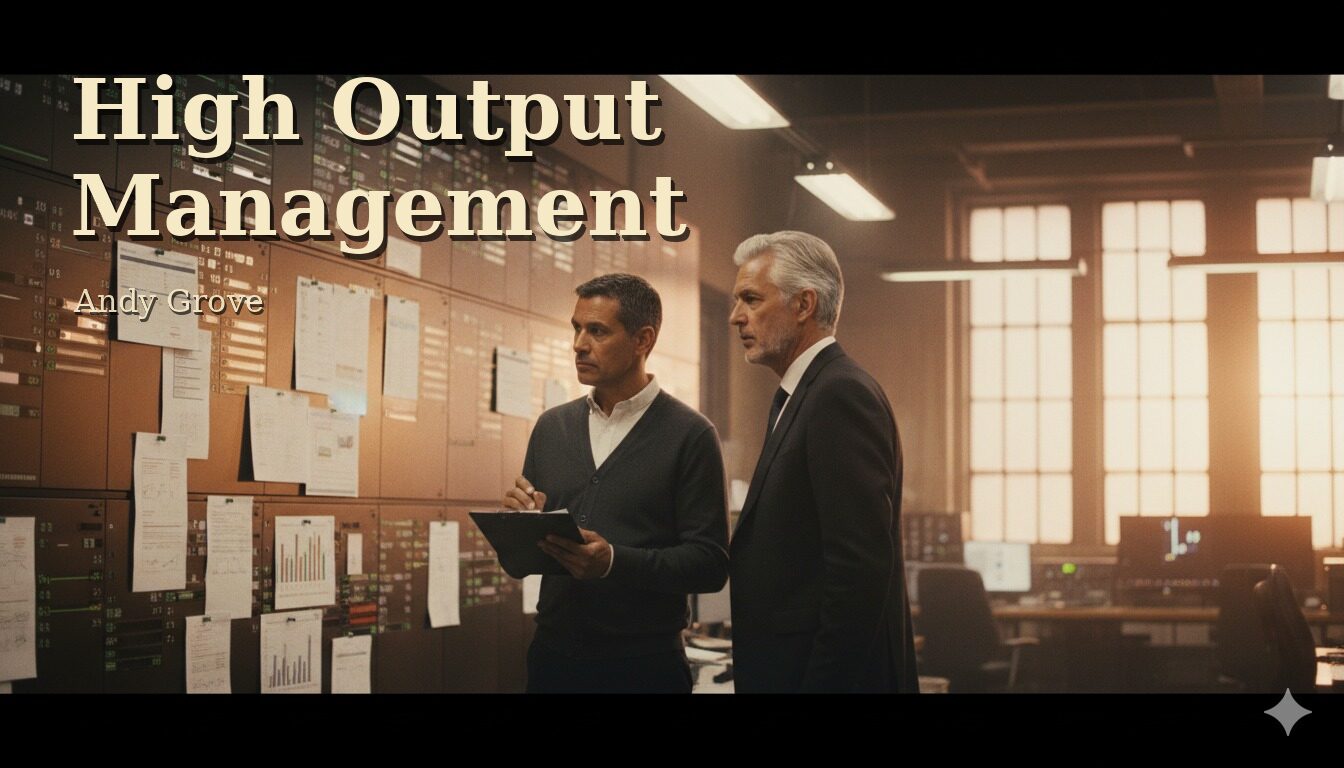
Andy Grove was not a consultant. He ran Intel for eleven years, growing the company from two to twenty-three billion dollars in revenue. High Output Management, published in 1983, is not a business-school book. It is the playbook of an executive who spent his career asking what, concretely, makes a manager effective.
The book was massively rediscovered in the 2010s by Silicon Valley: Ben Horowitz, Marc Andreessen, and Mark Zuckerberg all call it the most important management book ever written. But it is in French industry that it retains its greatest operational value, because it centers on concrete rituals, not theories. Three principles from the book still hold up forty years later.
01, A manager’s output is not their own output
The book’s founding idea, and the one that most changes an executive’s posture. A manager should not measure their personal output. They should measure the output of their team, and further still, the output of the teams they influence without having direct authority over them.
This is the absolute reverse of the dominant management culture, which pushes executives to show what they personally do: their meetings, their trips, their deliverables. Grove demonstrates the opposite: an effective manager actually spends very little time producing. They spend nearly all their time on three types of activity: gathering information (site visits, one-on-ones, reading the numbers), making decisions, and exerting influence, individual coaching, cross-functional communication, aligning adjacent teams.
This is the first diagnostic of a transition assignment. Ask a production director how they spend their week. If seventy percent of their time is in meetings, and they cannot say precisely what their six direct reports need to switch to first, that’s the problem to fix.
02, Task-Relevant Maturity: match the style to the task, not the person
The book’s most powerful conceptual discovery, and the most overlooked in France. Classic management advice (“directive manager” versus “participative manager”) is wrong, because it assigns a style to a person. The right level of management actually depends on the person’s maturity level on a specific task: their Task-Relevant Maturity.
The same team member can be low TRM on a new task they are just discovering (they need a directive, structuring style), medium TRM on a task they know but which has new dimensions (they need coaching), and high TRM on a task they have fully mastered: they need full autonomy. A good manager changes style depending on the task, sometimes several times in the same day with the same person.
The most useful tool for repositioning a leadership team: a TRM map, done in the first thirty days, of each direct report across their five critical tasks. The result is almost always striking: the same highly mature executive on two tasks, medium on two others, completely immature on the last, treated uniformly by their manager, which frustrates them where they could be autonomous and leaves them unsupported where they would need help.
03, The one-on-one: the most productive weekly ritual an executive can hold
The book’s signature ritual, and probably the most neglected one in French mid-sized industrial firms. Grove is categorical: a ninety-minute investment can improve the quality of a subordinate’s work for two weeks, while also deepening the manager’s understanding of what that person actually does.
The one-on-one as Grove practices it is weekly or biweekly, lasts sixty to ninety minutes, and (most importantly) the agenda is driven by the team member, not the manager. The manager asks more questions than they give instructions, and notes are taken by the team member, who thereby commits to their own actions.
Why is it so powerful? Because in the normal flow of an organization, a team member never spontaneously tells their manager what they should know. Issues surface through anomalies, delays, conflicts. The one-on-one reverses that flow: a direct, weekly channel where the team member brings their doubts, their ideas, their concerns. It’s the first discipline a transition manager should install by the second week.
Posture shift at an underperforming site
French industrial site, two hundred people, a tier-one supplier to a major automotive OEM. The outgoing site director was exhausted after four years, with burnout warnings from three direct reports and recurring late deliveries. The group brings in an industrial transition director for nine months.
Posture diagnostic: week one. Blunt finding: the outgoing director spent seventy-five percent of their time in meetings. Their six direct reports saw them an average of thirty minutes a week, in crisis mode. No structured rituals.
TRM mapping: weeks two and three. The result is striking: the quality manager, treated uniformly, is highly mature on three tasks and completely immature on one. The previous director micromanaged everywhere, hence the frustration. The new director recalibrates styles task by task.
One-on-ones installed: week three. Six weekly sixty-minute slots, never cancelled. The first four weeks are uncomfortable. By week six, the format takes hold: a quality risk that had never surfaced, team disengagement in one specific workshop, a commercial opportunity nobody had ever championed, all finally emerge.
At nine months, late deliveries are down by a factor of four, with no more burnout warnings. Three years later, the ritual is still in place.
What to remember
A manager’s output is their team’s output, not their own. If an executive is personally overwhelmed but their team is stagnant, the problem isn’t the site: it’s the posture.
Match the style to the task, not the person. A TRM map of direct reports across their five critical tasks unlocks an organization more than any reorganization could.
The weekly one-on-one is the most productive ritual an executive can hold. Sixty to ninety minutes, agenda driven by the team member, never cancelled.
French management culture still celebrates the overworked executive, present everywhere, personally producing a great deal. That is exactly the opposite of what Grove observed on the ground for thirty years: a lesson that also applies to a supply chain director or any executive running cross-functional teams.
An executive’s effectiveness is not measured by a full calendar. It is measured by what a team produces that they, most of the time, never touched directly.
Mounir Telkass: MT-Transition, industrial management transition firm.
A site under strain, a team to remobilize?
MT-Transition places transition directors who install lasting management rituals, not PowerPoint plans.
Response within 24 business hours.
Call: +33 6 59 15 73 54 Request a call back within 2 business hours