


Turn the Ship Around!: What a Nuclear Submarine Teaches About Industrial Leadership
How David Marquet turned the worst-performing crew in the U.S. Navy into the best: without replacing a single person. And why his principles apply word for word to your production teams. By Mounir Telkass, founder of MT-Transition.
☎ Call: +33 6 59 15 73 54 Request a call back within 2 business hours Callback within 2 business hours · 3 targeted profiles within 72h · 100% industrial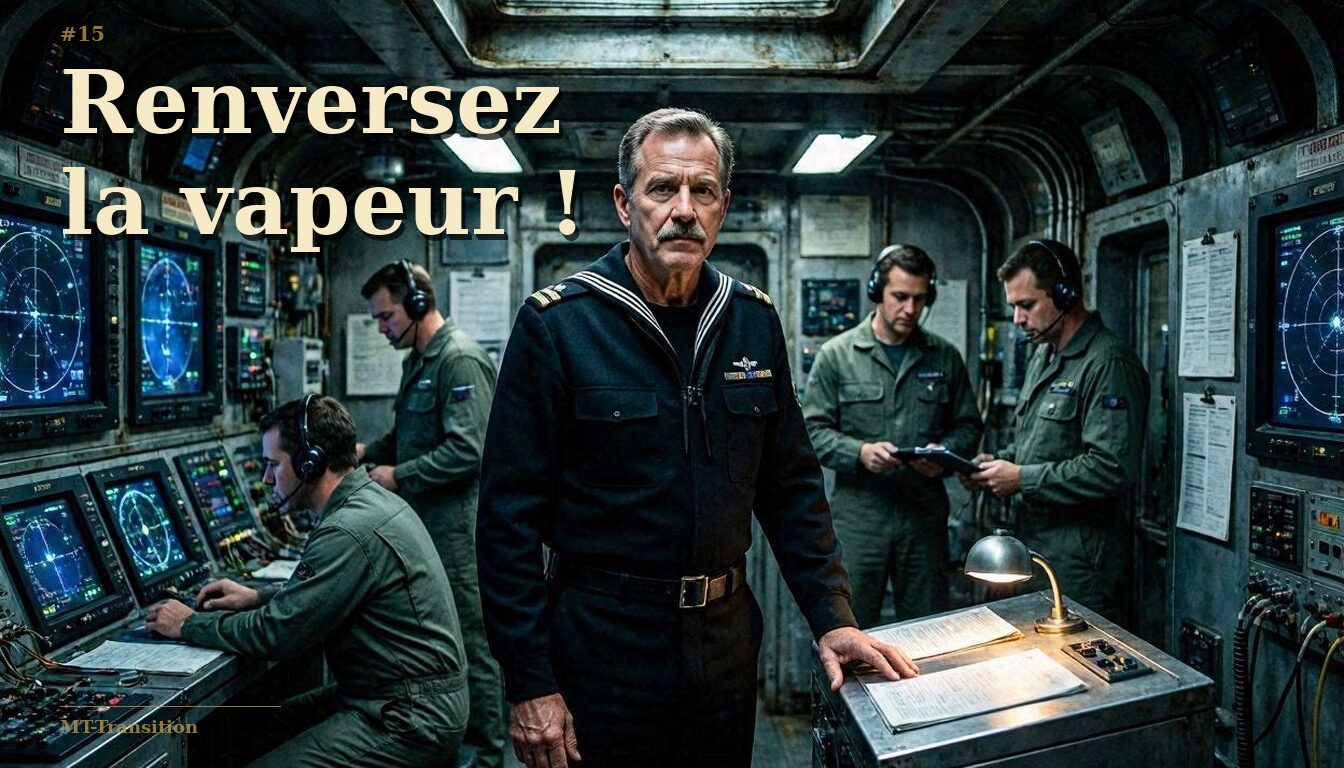
David Marquet was a U.S. Navy officer. In 1999, he took command of the USS Santa Fe, a nuclear-powered attack submarine ranked last out of 70 in performance, morale, and crew retention. Twelve months later, the same crew, without a single replacement, was ranked first. Turn the Ship Around!, published in 2012, is the account of that transformation, and the exposition of a management thesis that overturns thirty years of command doctrine.
The thesis fits in one sentence: “The problem with Tell culture is that it requires an ever-present authority to function.”
In other words: organizations built on the “the boss knows, everyone else executes” model can only function if the boss is everywhere at once. Which is, by definition, impossible. At 200 meters depth, in the dark, with a torpedo being loaded, Marquet could not be present at every station. His crew had to be able to decide. The problem: he had spent years training people who only knew how to do the opposite.
What he built aboard the Santa Fe is documented, reproducible, and directly applicable to a production shop floor, a maintenance team, a supply chain department.
1. Leader-Leader vs. Leader-Follower: choosing what kind of organization you want to build
“Leadership is not for the select few at the top of the organization. It is for everyone.”
Marquet explicitly names what most industrial organizations practice without theorizing it: the Leader-Follower model. The boss thinks, decides, directs. Teams execute, escalate problems, wait for decisions. This model has an apparent advantage: the decision chain is clear. It has a fundamental flaw: it concentrates all operational intelligence at a single point, which becomes simultaneously the bottleneck and the single point of failure.
The alternative model Marquet proposes is Leader-Leader: every level of the organization is trained to make decisions at its own level of competence and responsibility. The manager’s role is no longer to centralize authority: it is to distribute it intelligently, while maintaining strategic coherence.
The distinction is not about formal authority. An industrial director keeps decision-making power over the matters that concern them. What changes: they no longer become the mandatory checkpoint for every operational decision made by their field teams.
In a mid-sized manufacturing company, the symptom of the Leader-Follower model is visible to the naked eye. Technicians wait for the shop supervisor’s sign-off on decisions they could make themselves. The shop supervisor waits for the site director on calls he understands better than his superior. The site director is in permanent meetings because everything gets escalated. The organization is slow: not for lack of competence, but because of its decision-making architecture.
A maintenance manager at an automotive components plant decides to experiment with the Leader-Leader model on his team of 12 technicians. He stops signing off on corrective maintenance decisions below a certain cost and impact threshold. Result after six months: processing time for level-2 interventions is cut in half.
2. Intent-Based Leadership: stating your intentions instead of waiting for orders
“Instead of asking for permission, I want you to state what you intend to do. ‘I intend to submerge the ship’ rather than ‘Request permission to submerge the ship.’”
This is the most counter-intuitive technique in the book, and probably the most powerful. Marquet makes a precise observation: in a classic command model, team members ask questions. “May I do X?” This posture, however reasonable it sounds, signals something problematic: the person asking the question has given up exercising their own judgment.
Marquet changes the protocol. He asks his crew to stop asking for permission, and instead announce their intentions. “I intend to do X because Y. Is that correct?” The difference is radical: the person has already thought it through. They have formulated an analysis. They are taking a position.
In a transition management context, this technique is immediately applicable in operational meetings. When a team leader says “I think we need to stop line 3, the rate has been below the critical threshold for 48 hours: am I wrong?”, they have done the work. The final decision still rests with the transition manager, but the bulk of the thinking has already been done.
3. “Move authority to information”: the rule that flips the decision-making hierarchy
“Don’t move information to authority. Move authority to information.”
This is Marquet’s most-quoted formulation, and the one that meets the most resistance in highly hierarchical organizations. The classic logic goes like this: important decisions get escalated up to those who hold the authority.
Marquet flips the proposition: rather than moving information up to authority, give authority to whoever holds the information. The technician who sees the machine drifting in real time is better placed to decide to stop the line than the production director in a budget meeting 50 kilometers away.
The condition, and Marquet is explicit about this, is twofold: competence (the person knows what to do) and clarity (the person understands the objectives and constraints within which they are acting). Without competence, delegating creates chaos. Without clarity, even a competent team makes decisions inconsistent with strategy.
In French mid-sized companies, decision-making centralization is often as much cultural as organizational. An aerospace subcontracting company with 250 employees implements this principle on its quality control teams. Inspectors now have the authority to halt production without escalating to the quality manager: provided they have documented their analysis according to a precise framework. Result: the rate of non-conforming parts shipped drops by 40% within a year.
When the three techniques come together
A food industry company with 600 employees, three production sites. A transition manager is appointed director of operations to lead a logistics reorganization. He inherits teams that have operated in Leader-Follower mode for ten years: everything gets escalated, decisions are delayed, lines stop for arbitrations that could be made on the ground.
He starts with a simple diagnosis: he spends two days observing decision flows without intervening. He counts how many decisions that could be made by team leaders get escalated to him or to the level below him. The answer: 70% of day-to-day operational decisions.
He does not restructure the org chart. He changes the daily operational meeting protocol: team leaders stop asking questions. They announce their intentions. The first few weeks are uncomfortable. But after six weeks, operational fluidity changes in nature.
In parallel, he works with HR to clarify authority levels: who can decide what, up to what amount, with what criteria. By the end of the assignment, the logistics reorganization is in place. But what management takes away is that the teams started operating differently: even before the organization itself had changed.
3 takeaways
The Leader-Follower model has a systemic cost: it concentrates operational intelligence at a single point and structurally creates teams that wait. This cost is rarely visible until a crisis exposes it.
Changing the communication protocol changes the culture: asking teams to state their intentions rather than ask for permission is a concrete, immediately actionable lever, with no restructuring required.
Delegating without competence or clarity is destructive: the Leader-Leader model only works if both conditions are met. Distributing authority without having developed competence and clarity of objectives creates chaos, not autonomy.
A managerial transformation to lead at your site?
MT-Transition places industrial transition managers trained in these methods, ready to step in within a few weeks.
☎ Call: +33 6 59 15 73 54 Request a call back within 2 business hoursRelated pages
- Industrial Director for Transition Management
- Production Director for Transition Management
- Industrial HR Director for Transition Management
- Industrial Site Turnaround Assignment
- What is a Transition Manager?
Turn the Ship Around! is not a book about the Navy. It is a manual on what truly prevents an industrial organization from moving fast: the concentration of operational intelligence at a single point. Marquet proved it can be redistributed: provided you build, at the same time, the competence and clarity that make it safe.
Let’s talk about your situation
A first phone call, no commitment, to scope your need.
☎ Call: +33 6 59 15 73 54 Request a call back within 2 business hours← All articles