


70% of Strategic Plans Fail and It’s Almost Never the Strategy That’s at Fault
Larry Bossidy led Honeywell and AlliedSignal. Together with Ram Charan, he published Execution in 2002: the discipline that separates industrial transformations that hold from those that stall out in committee. By Mounir Telkass, founder of MT-Transition.
☎ Call: +33 6 59 15 73 54 Request a call back within 2 business hours Callback within 2 business hours · 3 targeted profiles within 72h · 100% industrial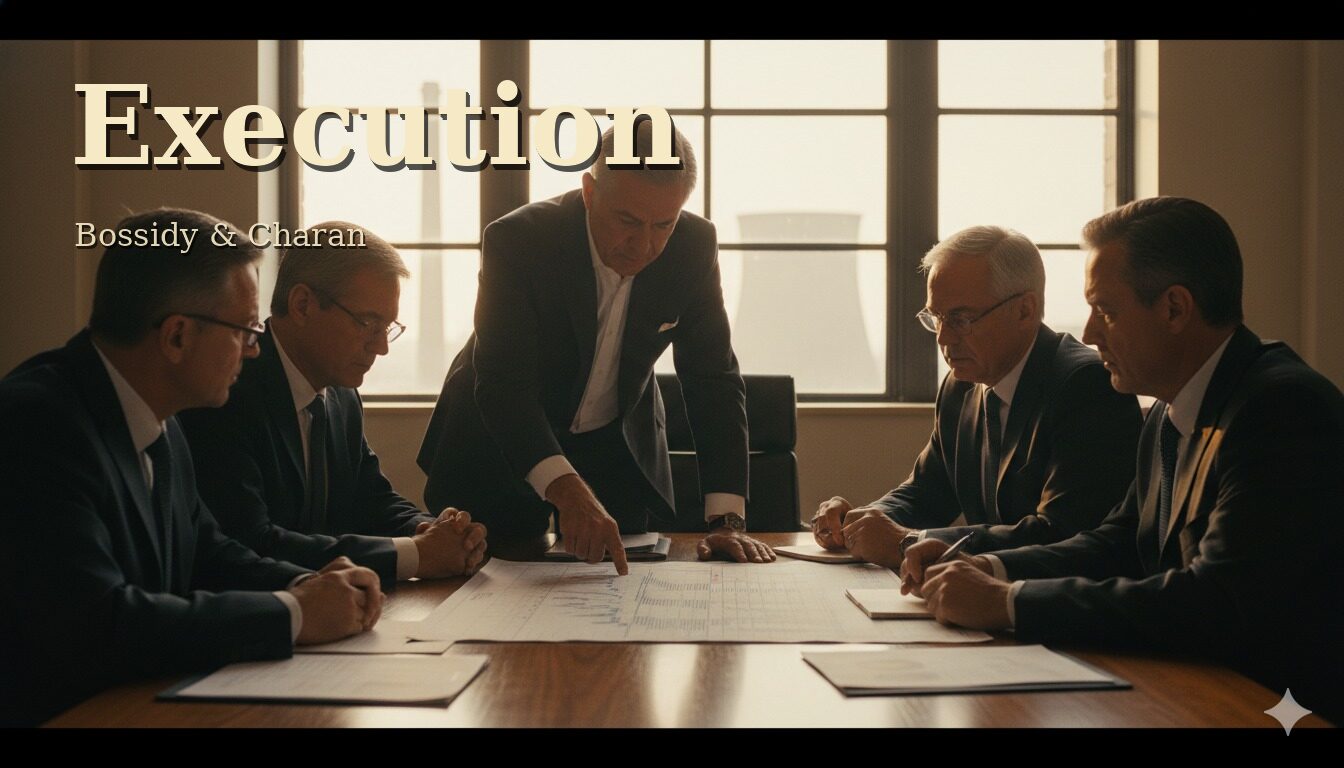
Three processes (people, strategy, operations) owned personally by the CEO.
Larry Bossidy led Honeywell and AlliedSignal: two of the largest American industrial transformations of the 1990s. Ram Charan is one of the most sought-after advisors to Fortune 500 CEOs. Together, they published Execution in 2002. The book became a classic because it stated a truth nobody wanted to put into words: execution isn’t a step that comes after strategy, it’s a discipline, and it’s almost always where transformations fail.
The book’s numbers became famous: between 60% and 70% of strategic plans fail to deliver the results promised. Not because the strategy is bad: it’s almost always reasonable. But because executive committees spend 80% of their time on strategy, 15% on operations, and 5% on people. It should be the other way around.
Three pillars of the book impose themselves on any industrial leader who wants their plan to hold.
Three processes, not one
Bossidy and Charan argue that any organization that executes well rests on three distinct processes, personally led by the CEO, whose alignment is non-negotiable: the People process (who are my people, what is each one capable of, who needs to move), the Strategy process (where are we going, against whom, on which growth levers), and the Operations process (how do we translate that into an annual plan, by site, with figures and milestones).
The trap nine executive committees out of ten fall into: treating them separately. Strategy is set in June during an offsite. Operations are set in November during budgeting. And the people process (if it exists at all) gets delegated to HR in March.
It’s probably the fastest diagnostic for an underperforming site: ask the general manager how they run their people / strategy / ops reviews across the year. In most cases, the answer is: he runs them, but not together, and not personally.
The people process is the most neglected
The book’s central chapter. Bossidy is direct: no company can deliver on its commitments if its leaders don’t practice the discipline of personal engagement with their teams.
No transformation plan succeeds if the CEO delegates deep knowledge of their managers.
For each of a site’s direct and second-level reports, the director must be able to answer without hesitation: what do they do very well? what do they do poorly? what could they be doing in three years? This information must be formally reviewed twice a year, in a talent review, and every review must produce concrete actions: training, promotion, mobility, exit.
This is the reverse of the dominant French practice, where the talent review is an HR ritual disconnected from operational decision-making. For a transition executive, it’s the priority from week one: a workstream typically led by the transition HR director in tandem with the CEO.
Robust dialogue
The book’s most quoted line: you cannot have a culture of execution without robust dialogue, a dialogue that surfaces reality through openness, candor and informality.
Three symptoms of an organization without robust dialogue: meeting conclusions are euphemisms, decisions aren’t written down, commitments aren’t tracked.
Robust dialogue demands three disciplines: say what you think, write down what you decide, track what was committed to. That’s what separates an executive committee that has met weekly for 5 years without executing anything, from one that makes its decisions, writes them down, and holds to them.
A transition assignment seen from the inside
French subsidiary of a German industrial group, 450 people, two sites. A transformation plan launched 18 months earlier: product portfolio overhaul, an operational excellence program, an indirect cost reduction plan. At 18 months, 30% of the plan had been executed. A transition CEO is brought in.
People process: One-hour interviews with each of the 8 direct reports, then 12 key second-level managers. Factual diagnosis: 3 of the 8 direct reports are not in the right role. Three internal moves, two external hires, one negotiated departure, all decided before the end of the first quarter: a scope close to what a PMI merger-acquisition assignment covers when a leadership team needs to be rebuilt.
Robust dialogue, Executive committee format redesigned: systematic opening review of prior actions, decisions logged live in writing. Within 6 weeks, the tone shifts.
Twelve months later: 80% of the previously stalled plan is executed. EBITDA recovers 1.8 points. No strategic decision was changed.
Key takeaways
Execution isn’t a step, it’s a discipline. It rests on three processes (people, strategy, operations), that must be owned personally by the CEO and aligned with each other.
The people process is the most important, and the most neglected. No plan succeeds if the CEO doesn’t know their managers in depth.
Robust dialogue is the sine qua non condition. Say what you think, write down what you decide, track what was committed to.
The book is about what happens after the strategy. And that’s precisely where industrial transformations are won, or lost.
Mounir Telkass: MT-Transition, industrial transition management firm.
A managerial transformation to lead at your site?
MT-Transition places transition CEOs and COOs who take execution personally: people, strategy and operations run together, not in silos.
☎ Call: +33 6 59 15 73 54 Request a call back within 2 business hoursRelated pages
- General Manager for Transition Management
- Industrial HR Director for Transition Management
- Industrial CFO for Transition Management
- Merger & Acquisition Integration (PMI)
- What is a Transition Management Firm?
- The Goal (Goldratt): Theory of Constraints
Let’s talk about your situation
A first phone call, no commitment, to scope your need.
☎ Call: +33 6 59 15 73 54 Request a call back within 2 business hours