


Why Your Leadership Team Leaves the Meeting Saying “We’re Aligned” and Executes Nothing Within 30 Days
Patrick Lencioni spent twenty-five years observing executive committees. His 2002 book maps a five-level pyramid that explains why so many leadership teams meet without ever truly deciding anything. By Mounir Telkass, founder of MT-Transition.
☎ Call: +33 6 59 15 73 54
Request a call back within 2 business hours
Callback within 2 business hours · 3 targeted profiles within 72h · 100% industrial
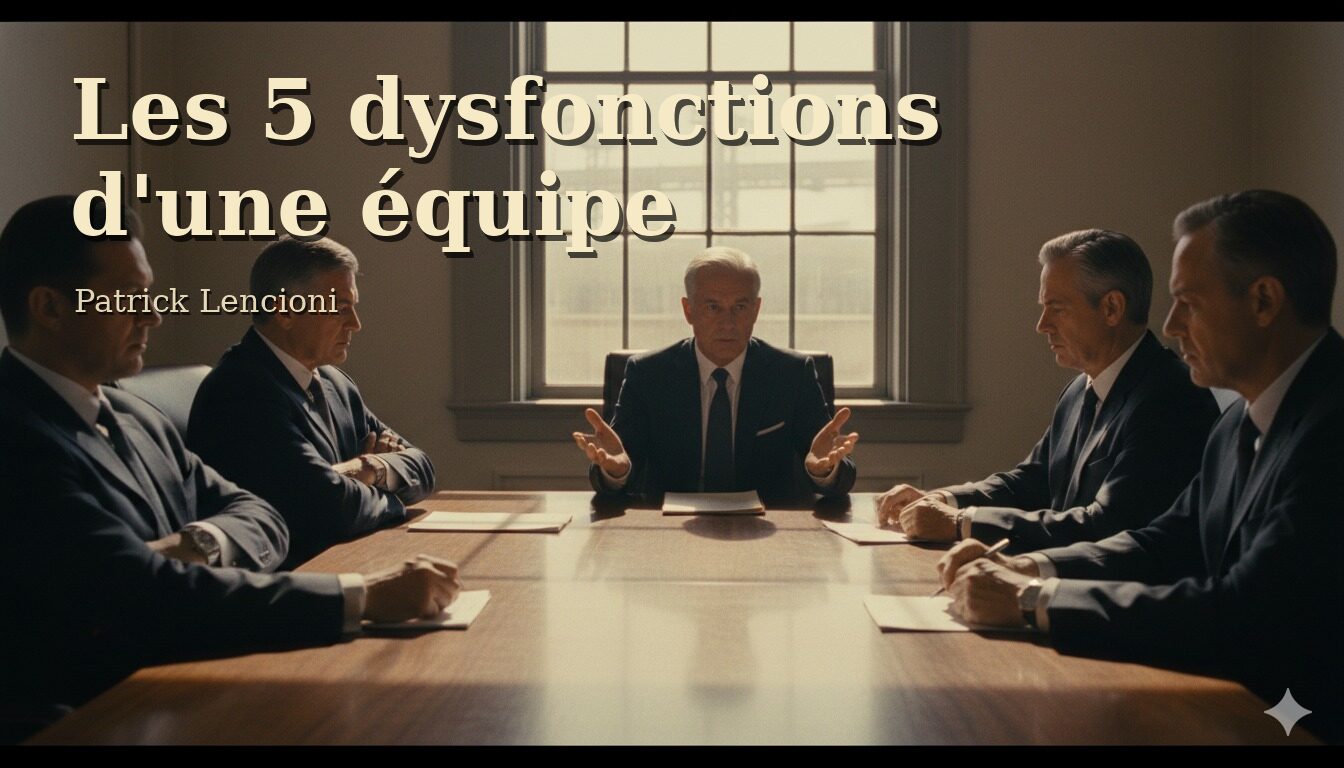
Trust, conflict, commitment: the leadership-team pyramid that actually executes.
Patrick Lencioni spent twenty-five years observing the executive committees of American companies. Not just the good teams. Not just the bad ones. All of them. And he eventually arrived at a simple thesis: nearly every leadership team on the planet suffers from the same affliction, layer by layer. And until you fix the bottom layer, the layers above it never hold.
His book, published in 2002, maps a five-level pyramid. Five dysfunctions that cascade into one another. Three levels carry the real diagnosis: the other two are simply the consequence. Those are the three levels worth reading closely for any executive who runs a leadership team.
The absence of trust is the foundation of everything else
Lencioni defines trust in a way that surprises most executives: it isn’t “I can count on this person to do their job.”
The ability, within a team, to be vulnerable with one another.
That means being able to say “I don’t know,” “I was wrong,” “I need help”: in front of your peers, without fear it will be held against you. In a leadership team that lacks this trust, everyone plays a role. The team becomes a collection of territories, not a team.
It’s the priority diagnosis for any transition manager taking over a leadership team. Not an HR audit. A factual observation of the first meeting: who speaks, who stays silent, who pushes back, who nods along mechanically. If no one admits a mistake, the bottom layer is broken: a diagnosis that any transition general manager makes systematically in their first week.
Fear of conflict produces false consensus
Without trust, there is fear of conflict. And a leadership team that fears conflict arranges to avoid it. How? By producing what Lencioni calls false consensus: a “yes, we agree” that reflects no real buy-in whatsoever.
He distinguishes two types of conflict: personal conflict (ad hominem attacks, power games), toxic. And productive conflict (factual debate, sometimes heated, on the substance) essential. Most French leadership teams avoid both out of confusion: substantive topics get wrapped in vague conclusions, and real disagreements get settled after the meeting.
This is what explains why 60% of transformation plans run out of steam within 6 months. Not because the decision was wrong. Because it was never truly made in the full sense of the word: confronted, debated, challenged, and ultimately owned by everyone.
Without conflict, no real commitment is possible
The book’s most powerful chain of logic. Lencioni puts it this way: a team only commits to what it has genuinely debated.
If a topic hasn’t been challenged, contradicted, defended, it cannot produce real commitment. It produces surface-level agreement instead. The transition manager must therefore set a simple rule in the first week: no decision leaves a leadership-team meeting without every member explicitly stating, out loud, whether they agree and why.
When a leadership team changes its format
A French industrial mid-cap, 600 employees, regional leader. A 9-person leadership team, in place for 4 years. Excellent surface-level climate. But the 2025 strategic plan won’t ship: 4 successive drafts, no sign-off. The chairman brings in an transition CEO.
Trust diagnosis: First meeting observed. No contradiction, no admitted mistake. In one-on-ones, seven of nine members mention a major disagreement never voiced in the meeting room. The bottom layer is broken.
Productive conflict: The transition CEO introduces a mandatory round-table where each person must state their disagreement or reservation. The first few meetings are uncomfortable. After 6 weeks, the tone shifts.
Commitment: Decisions are documented with an explicit position from each member. No more false consensus. At 12 months, the 2026 strategic plan is signed off in 2 meetings and delivered at 90% execution: a shift that echoes the principles of Execution by Bossidy and Charan on robust dialogue.
What to take away
Trust in a leadership team isn’t “I can count on this person.” It’s “I can be vulnerable in front of this person.” Without that, everything else collapses.
False consensus is the chronic disease of the French leadership team. Productive conflict has to be forced on the substantive issues.
Commitment isn’t an instruction, it’s a consequence. People only commit to what they’ve debated: a central principle for any transition industrial director taking over a fragile leadership team.
It’s probably in French industry, where the culture of avoiding conflict runs deepest, that these three principles are most useful to apply. And most uncomfortable to introduce.
Mounir Telkass: MT-Transition, industrial transition management firm.
A similar situation at your company?
Callback within 2 business hours. You’ll speak to an industry expert, not a salesperson.
☎ Call: +33 6 59 15 73 54
Request a call back
Callback within 2 business hours · 3 targeted profiles within 72h · 100% industrial
Related pages
Transition Industrial Director →
Transition Industrial HR Director →
Mission: SME Merger & Acquisition →
Transition Manager Daily Rate →