


Escaping the Price War: What Manufacturing Mid-Caps Can Really Learn From Blue Ocean Strategy
W. Chan Kim and Renée Mauborgne, professors at INSEAD, published Blue Ocean Strategy in 2005. It remains the framework most used by executives when their market starts suffocating on price. By Mounir Telkass, founder of MT-Transition.
☎ Call: +33 6 59 15 73 54
Request a call back within 2 business hours
Callback within 2 business hours · 3 targeted profiles within 72h · 100% industrial
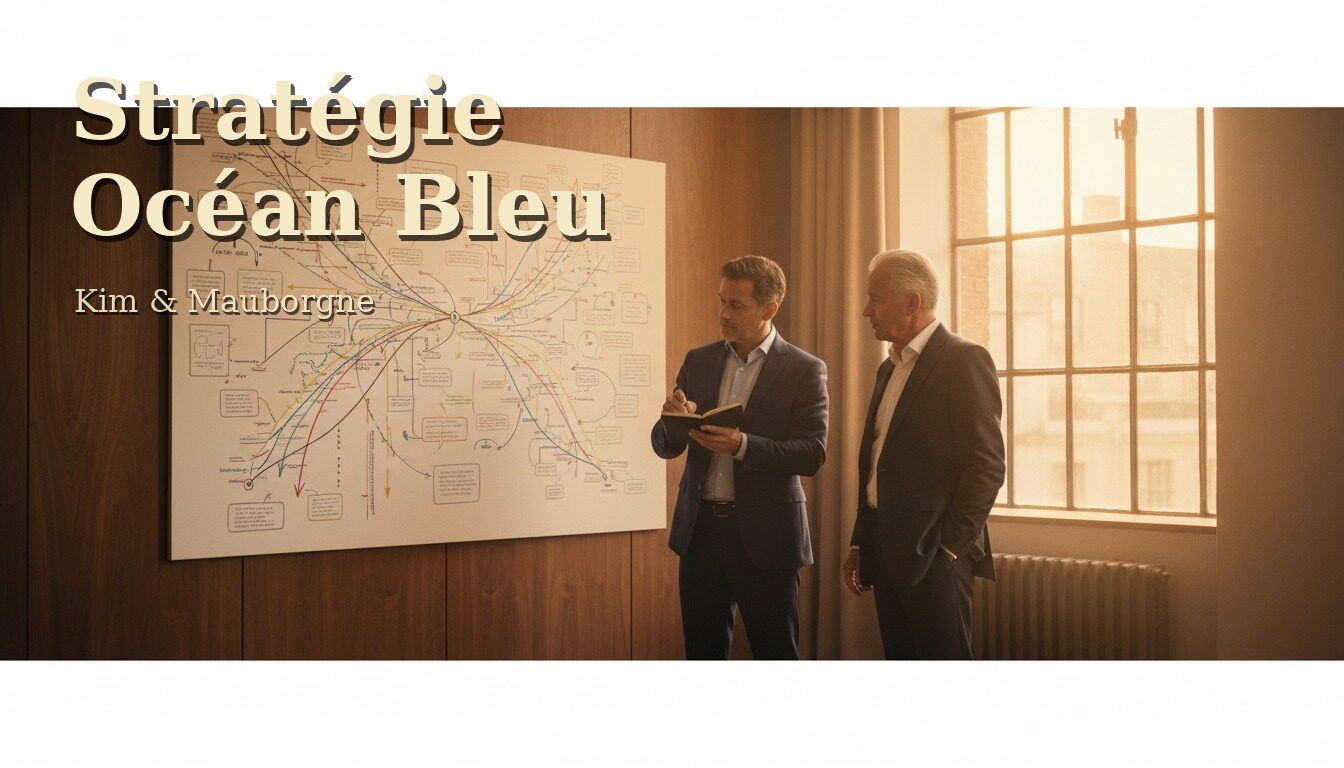
For decades, Michael Porter’s competitive framework dominated strategic thinking since the 1980s. Porter argued you had to choose: differentiation (superior offer, high margin) or cost leadership (standard offer, volume, low price). Kim and Mauborgne overturn that idea: in 80% of cases, markets that create lasting growth do both at once. That is what they call value innovation: the book’s signature idea.
Value innovation: differentiating and cutting costs at the same time
Stop competing: start creating.
Spending most of your time benchmarking against competitors is the most common strategic mistake. As long as you measure yourself against them, you stay in the same red ocean: the market everyone already knows, where growth comes only from taking share from a rival. A blue ocean is a space competitors haven’t thought to occupy: not a mythical untapped market, but a deliberately redesigned offer. This is exactly the deadlock an transition general manager faces when the natural reflex is to cut prices: the surest way to be dead within four years.
The ERRC grid: eliminate, reduce, raise, create
The book’s most powerful operational tool. A four-box grid that any executive committee can fill in within half a day: eliminate attributes taken for granted, reduce those set well below standard, raise those set well above it, and create attributes the industry has never offered.
The grid’s apparent simplicity hides its edge. Because it forces trade-offs. The ERRC grid confronts the CEO with mandatory renunciations: it’s unusable in “keep everything, add more” mode. It is a particularly powerful tool for pushing a strategic break through an executive committee used to benchmarking against competitors, especially in sectors under pressure such as automotive or food processing.
Escaping the price war
A French manufacturing mid-cap, 350 employees, a supplier in a legacy sector. Margins cut in half over six years. Asian competition on the low end, vertical integration by major accounts on the high end. An transition CEO is brought in.
Strategy canvas: First week. The transition CEO has the executive committee chart the attribute curve of the sector’s five main players. The overlap is striking: the five curves are nearly identical.
ERRC grid: Second week. A full-day workshop with the executive committee and four field sales reps: eliminate the highest-end range, reduce standard delivery lead time, raise pre-project support, create an in-factory pre-assembly service.
Value innovation, The redesign changes the cost structure: the high-end range is dropped, logistics are optimized, a new pre-assembly service carries structurally higher margin. Eighteen months later: gross margin restored +6 points, 14% growth on the new service, no price cut on the standard range.
What to remember
As long as you measure yourself against competitors, you stay in the same red ocean. The right response for a mid-cap with eroding margins isn’t a price cut: it’s redesigning the offer.
The ERRC grid forces the trade-offs no strategy committee likes to make. If you don’t know what to eliminate, you don’t have a strategy: you have a wishlist.
The strategy canvas shows an executive committee what no report ever does. It’s the most effective unlocking tool, including for an transition procurement director facing a market where every supplier looks alike.
A similar situation at your company?
Callback within 2 business hours. You’ll speak to an industry expert, not a salesperson.
☎ Call: +33 6 59 15 73 54
Request a call back
Callback within 2 business hours · 3 targeted profiles within 72h · 100% industrial
Related pages
Transition Procurement Director →
Mission: SME Merger & Acquisition →